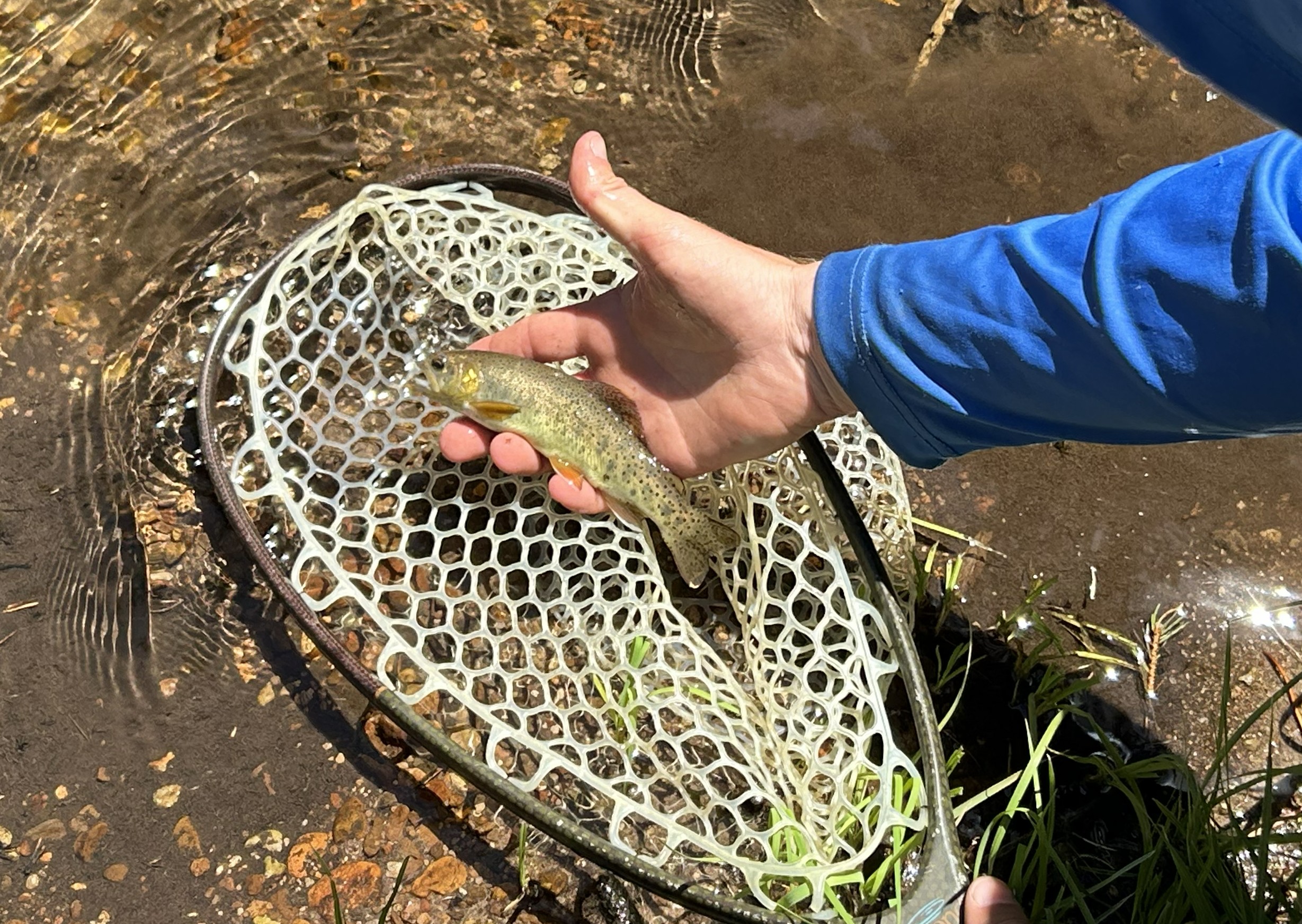
At the base of Mount Baldy in eastern Arizona, where snowpack has melted and runoff flows into a live yet lazy stream called the West Fork of the Little Colorado River, the native Apache trout are thriving after their comeback from near extinction.
Cool alpine meadows and clusters of aspens on the eastern flank of Mount Baldy — the second-tallest mountain in Arizona at 11,421 feet — afford anglers a steady hiking trail that winds near the creek and through this green-streaked paradise in Greer, Ariz.
Near one such bend, rife with protective logs and rocks and a bank eroded into a deep undercut, a wild Apache trout lurks. Flows are minimal — prolonged drought in the western United States has produced slower-and-lower average summertime flows. Yet the stream still harbors deeper holes with incredible potential for fly anglers hoping to hook a speck of history.
A No. 12 white spider fly taps the surface. It rides a riffle and bends, tiny legs dancing. Then a boil.
A fly rod bows to the regal, golden-hued Apache trout.

Apache trout caught on a No. 12 spider at West Fork Little Colorado River in Greer
Moments later, the fish is carefully scooped into a plastic net and quickly released.
Your turn.
Anglers now benefit from conservation efforts that began with the White Mountain Apache Tribe decades ago, culminating in 2024 when numerous federal, state, and tribal agencies celebrated the Apache trout’s recovery and removal from the Endangered Species Act (ESA) — making Arizona’s state fish the first trout species ever delisted due to recovery.
The Apache trout has overcome primary threats of overfishing in the late 19th and 20th centuries, hybridization, competition from nonnative trout, and habitat loss, including the devastating 2011 Wallow Fire.
And conservation efforts have only increased.
Turns out, the delisting has helped propel more Apache-protecting projects.
Apache trout angling methods

The West Fork of the Little Colorado River is the largest and most accessible stream for anglers hoping to catch the highly sought-after Apache trout. There are several parking lot-paved access points. The best time of the year for Apaches is typically June to October, but be on the alert for dangerous monsoon activity in July-September. Take shelter immediately to avoid flash flooding.

Arizona Game and Fish Department (AZGFD) Native Trout and Chub Coordinator Alex Loubere suggests anglers check water temperatures and focus fishing efforts on the early morning periods during the summer since water temperatures can get warm in the afternoon, even during monsoon season. He added anglers may find 20–30 fish in a single pool in some spots.
Apache trout are spooky, so anglers are encouraged to use stealth — even neutral clothing colors. “I’m one of those guys who likes to wear a camouflage shirt,” Loubere said. “Also be careful with your foot fall and movements.”
That said, Apache trout are indiscriminate feeders — they might hit stonefly, mayfly or caddisfly imitations, or terrestrial patterns such as spiders, ants, beetles and hoppers. Also, wet flies and nymphs such as woolly buggers and prince nymphs have been known to dupe Apaches. Try varying your approach and setup, such as tying a dropper rig with a grasshopper pattern or a spider at the surface to cover different areas of the water column.
Sam Simmons, AZGFD’s Mesa-region streams biologist, has fished streams such as the West Fork of the Little Colorado River, catching dozens of fish, then logging the GPS location of each catch. Overwhelmingly, he hooked fish near stream bends with undercut banks and structures such as boulders or logs. Simmons is just one trout enthusiast who lauds this rebound of Arizona’s state fish.
All thanks to a decades-long conservation coalition.
Second-half playbook: post-delisting strategies boost Apache protection

Did the delisting mean conservation cruise control? Hardly.
“If anything, we’re turning conservation efforts up a notch, because we now have more wiggle room on the compliance side to work on those streams,” Loubere said. “We plan to do way more work during the next 10 years — especially habitat restoration.”
One benefit: AZGFD is no longer required to route habitat restoration requests through the U.S. Forest Service.
Likewise, Trout Unlimited (TU) has shifted from compliance-heavy work to project execution. Delisting removed major environmental review hurdles — like the large Environmental Impact Statement process tied to projects such as the Black River Environmental Assessment — that had previously restricted work windows around spawning seasons, fish removal requirements, and critical habitat rules. That’s opened up year-round flexibility for stream and creek work.
“Once the species was delisted and off the ESA, it got a lot easier to work in the creeks and streams,” said Nathan Rees, Trout Unlimited’s Arizona State Director. “It opened up a lot of flexibility for when we can work throughout the calendar year.”
Trout Unlimited Arizona is currently managing 14 active projects.
A couple highlights:

Thompson-Burro Meadow Restoration Project, on the Apache trout-rich West Fork of the Black River and led by Trout Unlimited, is a $1.8 million project to fully restore approximately 3.5 miles of stream and reconnect 128 acres of wet meadow in the White Mountains that had been cut off from its floodplain due to historical drought and wildfire degradation.
Rather than heavy equipment-driven engineering, this is “low-tech, process-based restoration” inspired by beaver dam analog projects. LiDAR imaging revealed historic structures that once held seasonal water and pushed it into side channels.
“For TU’s Thompson-Burro meadow restoration project we placed structures in the main perennial channel, as well as side channels,” Rees said. “This helps back the water up, reconnecting it to the floodplain, and raising the water table of the wet meadow. Having a well-functioning wet meadow takes the energy out of spring runoff and monsoon flooding — dissipating that energy means much less erosion and sediment transported to downstream reservoirs and users in the Phoenix Valley.”

The project, underway with its final phase expected around 2028, has already completed instream restoration that includes more than 200 wood logjam structures and 70 sod plugs that slow water flows throughout the meadow, allowing it to spread and replenish groundwater levels.
A second phase, roughly one-third complete as of mid-2026 and scheduled to finish by the end of 2026, involves elk exclusion fencing across 258 acres to protect the 128-acre meadow and let vegetation establish.
Phase three includes roughly 75,000 plantings — native grasses, sedges, pollinator species, willow, and some conifer — under a contract with Northern Arizona University.
AOP (Aquatic Organism Passage) projects: TU is replacing undersized culverts (3–4 feet in diameter) with wide, bottomless arch culverts (roughly 21 feet wide), allowing fish passage at all life stages. These are reconnecting 9.3 miles of stream habitat at Paradise Creek within the White Mountain Apache Reservation.
An Apache-filled future

The recovery of Apache trout marks an enormous victory for fly-fishing enthusiasts chasing Arizona’s gold standard of trout fishing.
One AZGFD survey has already indicated success in post-delisting Apache trout populations. Loubere reported that in June of 2025 on the East Fork of the Little Colorado River (near the West Fork), a survey indicated the Apache population was remaining stable despite ongoing drought.
The biggest obstacle to keeping Apaches delisted? Not angling. Loubere said: “I consider angling a net positive because of the funds it brings in for conservation.”
Namely, the biggest threats are drought, wildfires and nonnative trout outcompeting the native trout for food. As such, AZGFD heavily engages in removals of brown, brook and rainbow trout.
Yes, future anglers will benefit from these conservation efforts that are accelerating – despite the historic delisting.
Said Rees: “Now we’re really stomping our feet on the gas.”